Butter vs. Margarine: What's Actually Happening in Your DoughMantequilla vs. Margarina: Lo Que Realmente Sucede en tu Masa
I used the same cookie recipe, one with butter and one with a variation of margarine. The margarine cookie spread out flatter and was cakier, while the butter cookie was thicker and chewier with a deep-brown color and a crisp edge. But texture wasn’t the only difference. The biggest difference was in the taste. The butter cookie had a rich, browned flavor, while the margarine cookie was missing the deeper, toasted flavor the butter cookie had. So what's causing these visual and flavor differences? Usé la misma receta de galletas, una con mantequilla y otra con una variación de margarina. La galleta de margarina se extendió más plana y quedó más esponjosa, mientras que la galleta de mantequilla quedó más gruesa y masticable, con un color café oscuro y un borde crujiente. Pero la textura no fue la única diferencia. La mayor diferencia estuvo en el sabor. La galleta de mantequilla tenía un sabor rico y tostado, mientras que a la galleta de margarina le faltaba ese sabor más profundo y tostado que tenía la de mantequilla. Entonces, ¿qué está causando estas diferencias visuales y de sabor?
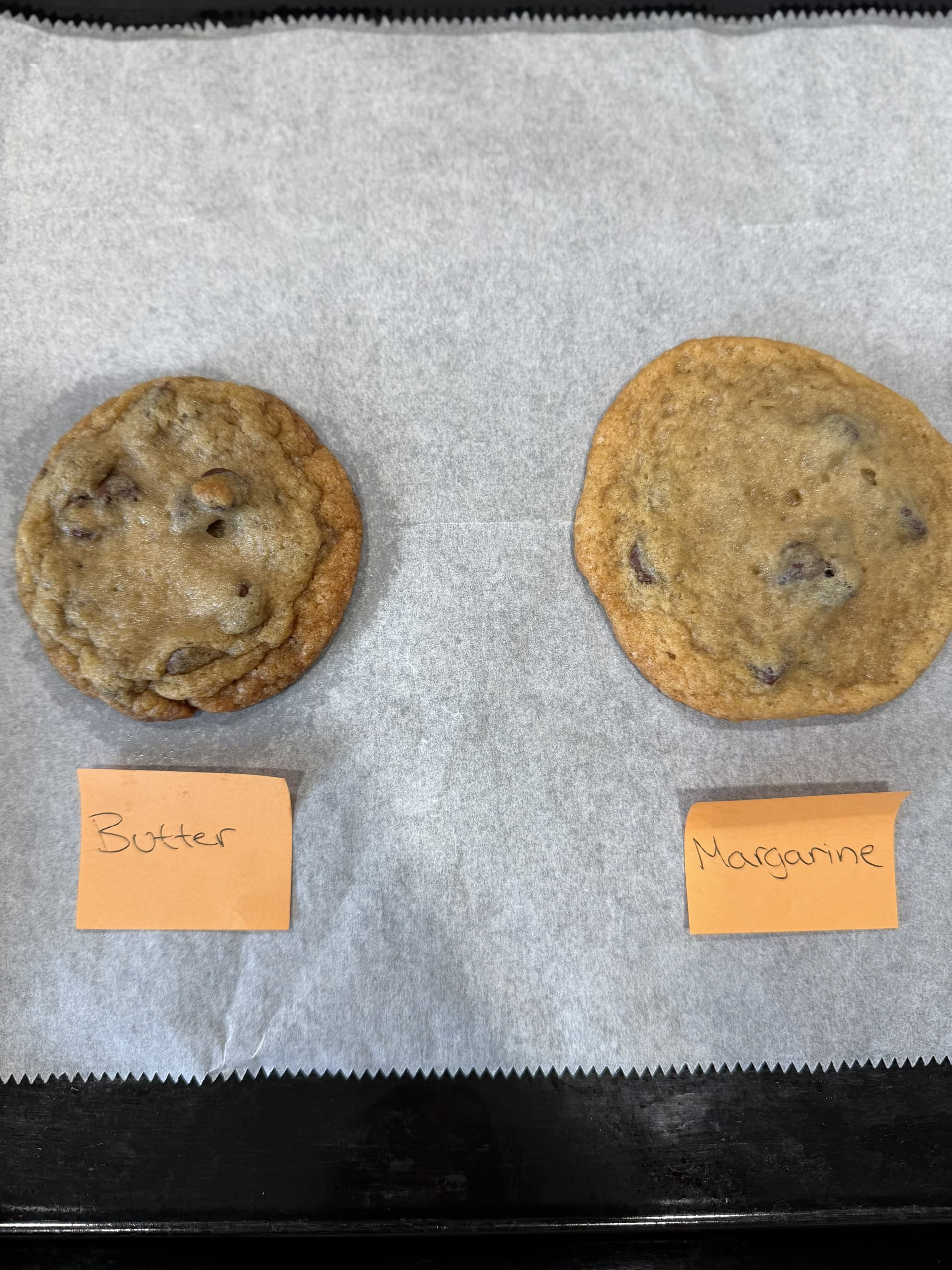
What's actually different in these two identical-looking ingredients?
Butter is made by churning cream and contains about 80% fat and 16–18% water. Margarine is made from vegetable oils (often blends like soybean, palm, palm kernel, corn, or canola), engineered to match butter's ratio, also about 80% fat, with water making up most of the rest, plus small amounts of emulsifiers and flavoring to mimic butter's taste and texture.
If they're made of almost the same fat-to-water ratio, why do they bake so differently?
Both Butter and margarine are made of fat crystals that trap air differently during creaming, affecting the rise and airiness of a cookie. This depends on the temperature of the butter. Beating room-temperature butter incorporates air to make fluffy baked goods, while beating melted butter can't trap air, resulting in a dense and flat cookie. Margarine's crystal structure, on the other hand, depends on the manufacturer. It's often engineered to trap air more consistently than butter. Temperature still matters for margarine too. Melted margarine won't trap air any better than melted butter, but a well-made margarine tends to hold its crystal structure more consistently across a wider range of handling than butter does.
During baking, that water in butter and margarine turns into steam. In cookies, this adds a small amount of extra lift, but steam's biggest effect shows up in doughs like pie crust. The cold butter is cut into visible chunks. The steam pushes those layers apart, creating a flaky texture. Margarine, especially stick, with a similar fat-to-water ratio can produce a similar effect, but low-fat, high-water spreads don't. They lack the fat structure the steam needs to push against, so they usually turn out soggy or dense instead of flakier.
Butter's melting point is close to our body temperature, so it melts smoothly and evenly the moment it touches your mouth, causing that "rich" taste. Margarine can have a different melting point, so it may not fully melt as quickly, which can feel slightly waxy in comparison.
Which is better?
It depends on what you're trying to accomplish. Butter wins on flavor. When butter browns, the milk solids toast at the bottom of the pan, creating that deep, nutty flavor. Margarine can't brown the same way because it's made from vegetable oil and water. It has no milk solids to toast. When margarine is heated past its melting point, the oil and water separate, and the oil can burn rather than developing that same nutty aroma.
Margarine wins on consistency. Because manufacturers control margarine's crystallization process, they can produce a very uniform product, which matters more in commercial baking, where predictable results are more important than flavor. Butter's structure depends on how it's handled, so if you're not experienced with it, you won’t always get consistent results.
Which is healthier?
This question is still an open debate. Margarine before 2018 contained trans fat, which was considered unsafe and has been replaced. There's still no clear answer on which fat is 'healthier' overall. Research on the newer fat-processing methods used in margarine is mixed, with some studies finding no meaningful effect on cholesterol markers and others finding possible unfavorable shifts, depending on the specific fat involved.
Qué es realmente diferente en estos dos ingredientes que se ven idénticos?
La mantequilla se elabora batiendo crema y contiene aproximadamente 80% de grasa y 16–18% de agua. La margarina se elabora a partir de aceites vegetales (a menudo mezclas como aceite de soya, palma, palmiste, maíz o canola), diseñada para igualar la proporción de la mantequilla, también con alrededor de 80% de grasa, con agua conformando la mayor parte del resto, además de pequeñas cantidades de emulsionantes y saborizantes para imitar el sabor y la textura de la mantequilla.
Si están hechas casi con la misma proporción de grasa y agua, porqué se hornean de manera tan diferente?
Tanto la mantequilla como la margarina están hechas de cristales de grasa que atrapan el aire de manera diferente durante el batido, lo cual afecta el crecimiento y la esponjosidad de una galleta. Esto depende de la temperatura de la mantequilla. Batir mantequilla a temperatura ambiente incorpora aire para lograr productos horneados esponjosos, mientras que batir mantequilla derretida no puede atrapar aire, dando como resultado una galleta densa y plana. La estructura cristalina de la margarina, por otro lado, depende del fabricante. A menudo está diseñada para atrapar aire de manera más consistente que la mantequilla. La temperatura también importa para la margarina. La margarina derretida no atrapará aire mejor que la mantequilla derretida, pero una margarina bien elaborada tiende a mantener su estructura cristalina de manera más consistente en un rango más amplio de manejo que la mantequilla.
Durante el horneado, esa agua presente en la mantequilla y la margarina se convierte en vapor. En las galletas, esto agrega una pequeña cantidad de crecimiento adicional, pero el mayor efecto del vapor se nota en masas como la de la tarta (pie crust). La mantequilla fría se corta en trozos visibles. El vapor empuja esas capas para separarlas, creando una textura hojaldrada. La margarina, especialmente la de barra, con una proporción de grasa y agua similar, puede producir un efecto parecido, pero las untables bajas en grasa y altas en agua no lo logran. Les falta la estructura de grasa contra la cual el vapor necesita empujar, por lo que suelen quedar aguadas o densas en lugar de hojaldradas.
El punto de fusión de la mantequilla está cerca de la temperatura de nuestro cuerpo, por lo que se derrite de manera suave y uniforme en cuanto toca la boca, provocando ese sabor "rico". La margarina puede tener un punto de fusión diferente, por lo que podría no derretirse tan rápido por completo, lo cual puede sentirse ligeramente ceroso en comparación.
Cuál es mejor?
Depende de lo que estés tratando de lograr. La mantequilla gana en sabor. Cuando la mantequilla se dora, los sólidos lácteos se tuestan en el fondo del sartén, creando ese sabor profundo y a nuez. La margarina no puede dorarse de la misma manera porque está hecha de aceite vegetal y agua. No tiene sólidos lácteos que tostar. Cuando la margarina se calienta más allá de su punto de fusión, el aceite y el agua se separan, y el aceite puede quemarse en lugar de desarrollar ese mismo aroma a nuez.